
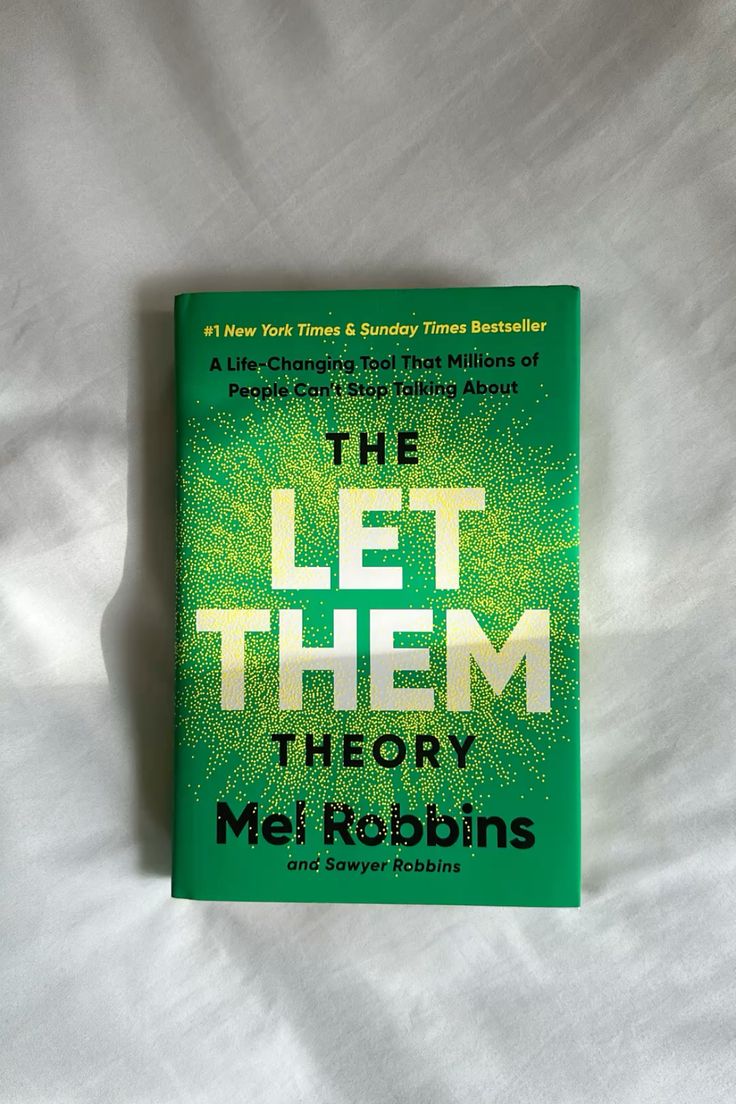
A colleague leaves your message unread. A friend cancels again. Somebody makes a decision you dislike, and suddenly the next hour belongs to a conversation that has not happened, an explanation you cannot get, or an argument taking place only in your head. The Let Them Theory begins at that exact point: let their choice be real, then decide what you will do with your attention.
Mel Robbins’ book is popular because the first half sounds almost too simple: let them. Let them be late, disagree, exclude you, misunderstand you, choose differently, or reveal a priority you do not like.
But those two words are only the release valve. The useful part comes next: let me. Let me set a boundary, make another plan, ask a direct question, leave the argument, do the work, or stop waiting for someone else to make the day feel settled.
The Book in 60 Seconds
*The Let Them Theory* is Mel Robbins’ 2024 book about the energy people lose trying to manage other people’s behaviour, opinions, moods, and choices. It is not a book about becoming detached from everyone. It is a book about seeing the line between influence and control.
The central promise is practical: when you stop fighting what another person is already choosing, you recover attention for your own response. The book applies that move to family, friendship, work, dating, comparison, and the everyday urge to make people act how you think they should.
Its biggest strength is that it gives a short name to a familiar problem. Most overthinking is not a lack of intelligence. It is the mind repeatedly trying to solve a person-sized problem you do not own.
The Let Them Theory is a mindset tool that helps you stay focused on what you can control.Mel Robbins, The Mel Robbins Podcast, episode 246, 2024
That sentence is the whole book in useful form. You are allowed to care about what people do. You are allowed to speak, ask, leave, negotiate, protect yourself, or make a different choice. You just stop treating their response as a task you can complete for them.
The Central Model: Let Them, Then Let Me
The first move, Let Them, names reality without immediately wrestling it. If a team member is defensive, let them be defensive. If a friend is not making time, let them show you that. If people judge a decision, let them have their view.
This does not mean you agree. It means you stop spending the first ten minutes pretending you can force a different person to be different through more worry, better wording, or internal debate. Reality becomes visible sooner when you stop negotiating with it in private.
The second move, Let Me, prevents the idea becoming passive. Ask: given what is actually happening, what is mine to do? You may make a request, change the plan, protect your time, lower your expectation, offer help once, or choose not to participate.
The sequence matters. If you jump straight to “let me” while still trying to control them, your action is usually disguised pressure. You send the careful text hoping it makes them apologise. You work later hoping it makes someone value you. You say yes hoping it changes their opinion.
Let Them removes the hidden bargain. Let Me gives you a clean action that is worth doing even if nobody changes.
You can’t control other people. Your power is in controlling your response to other people.Mel Robbins, The Mel Robbins Podcast, episode 237, 2024
That is a sharper rule than “do not care what people think.” You should care when a relationship, customer, colleague, or family member gives you useful information. The point is to use the information rather than surrender your day to it.
The Three Ideas Worth Keeping
First, other people’s behaviour is data. If someone repeatedly cancels, you do not need a courtroom case to prove they are wrong. Their pattern tells you something about their capacity, priority, reliability, or the relationship as it currently exists.
Data is calmer than a story. “They cancelled twice” is data. “They do not value me and never will” is a story. The first gives you options. The second keeps you trapped in an answer you cannot verify.
Second, a boundary is an action you take, not an order you give. “You need to stop texting me late” asks somebody else to become the solution. “I will answer messages tomorrow” tells you what you will do. The first may be reasonable; the second is within your control.
Third, comparison often hides an impossible assignment. Someone else gets promoted, travels more, gets invited, posts a better result, or seems further ahead. Let Them means allowing their life to be their life. Let Me asks what small move would make your own week more honest or more useful.
That move may be uncomfortable. You may need to apply, practise, ask for feedback, spend less, make a call, or admit that a goal matters. But discomfort attached to your own action is cleaner than the endless discomfort of monitoring somebody else’s score.
How to Use the Theory at Work
Imagine you are waiting for a colleague to approve a document. They have been slow for days. The usual reaction is to keep checking, draft increasingly irritated messages, and let the delay occupy every gap in your attention.
Let Them: they are delayed. You cannot make their inbox behave through rumination. Let Me: send one clear note with the decision needed and a date, then identify the work that can move without approval. If the deadline passes, escalate through the agreed channel rather than restarting the private frustration loop.
The theory does not make the delay acceptable. It stops the delay from controlling two problems at once: the blocked work and your attention. You deal with the first through a visible process. You protect the second by returning to what can move.
The same rule helps in meetings. If somebody wants to dominate the room, let them show that behaviour. Then let yourself ask the question, name the decision, make space for another voice, or leave with your own next step. You do not need to win every social contest to make a useful contribution.
The Five-Minute Control Reset
Use this reset when you notice yourself replaying somebody else’s choice. It takes five minutes and works best before you send another message, open a social feed, or decide the whole relationship from one moment.
First, write the fact without an interpretation. “They said no.” “They have not replied.” “They chose somebody else.” “They changed the plan.” This step is small, but it separates what happened from the story your mind is building around it.
Second, write “Let Them” beside the fact. You are not endorsing it. You are dropping the fantasy that more analysis can make the event un-happen. Let the person own their choice and its consequences.
Third, finish the sentence: “Let Me ____.” The blank must be an action you can take today. Let me ask once. Let me work on the proposal. Let me make another plan. Let me take a walk before I answer. Let me say no next time. Let me book the block that matters to me.
Rize AI gives this final step somewhere real to live. When your next action is a ten-minute conversation, a protected work block, or an evening without the phone, schedule it around the day you actually have. The point is not to journal a better response. It is to make the response happen.
A Normal Example: The Friend Who Never Confirms
A friend says they want to meet, then repeatedly leaves plans vague. You keep your weekend open, check your phone, feel rejected, and eventually send a message that carries months of unspoken disappointment. The friendship becomes a question you keep trying to answer alone.
Let Them means allowing the pattern to tell the truth about their availability right now. It does not require you to call them selfish. It does not require you to pretend it does not hurt. It stops you from building your whole weekend around a promise they have not kept.
Let Me could be: make plans you would enjoy either way, invite them once with a clear deadline, or have one honest conversation about what you need from the friendship. Each response respects both people more than waiting in silence and hoping they become more reliable.
That is the book’s practical gift. You do not need to punish people for showing you who they are. You need to use the information to choose your own next move.
What People Get Wrong About Let Them
Let Them is not permission to ignore harm, tolerate disrespect, or remain in unsafe situations. If a person is abusive, threatening, or repeatedly violating a boundary, the useful action may be distance, support, documentation, or professional help. Acceptance of reality should make protection clearer, not weaker.
It is also not a way to avoid a needed conversation. Sometimes the action you control is saying, “When this happens, it affects me this way, and I need this to change.” Let Them asks you not to control the answer. It does not ask you to hide the request.
Finally, do not use the phrase to become emotionally lazy. “Let them” is not a substitute for listening, accountability, or repairing your own mistake. It is a tool for choosing where your energy can produce a result.
Run a Ten-Day Let Them, Let Me Test
For ten days, catch one moment a day when another person’s behaviour starts running your attention. Use the five-minute reset: write the fact, write Let Them, and choose one Let Me action that does not depend on their cooperation.
At the end of each day, record only two things: what were you trying to control, and what did you do instead? Do not score whether the other person improved. That would turn the experiment back into the same trap.
After ten days, look for the repeated category: unanswered messages, comparison, family pressure, team friction, or plans that stay vague. That category is where a boundary, calendar change, direct conversation, or smaller expectation will create the most relief.
The goal is not a quieter life because nobody disappoints you. The goal is a more directed life because disappointment no longer gets first claim on your attention.
- Catch one control loop today. Write the fact without the story around it.
- Say ‘Let Them’ privately. Release the attempt to manage a choice that is not yours.
- Finish ‘Let Me ____.’ Choose one action that improves your next hour without needing their cooperation.
- Repeat for ten days. Use the repeated pattern to decide where a real boundary or calendar change belongs.
The rules worth keeping
Treat another person’s repeated behaviour as information, not a puzzle you must solve for them.
Name what happened before adding an interpretation about what it means.
Stop acting mainly to make another person change, apologise, or approve.
Turn the freed attention into one action you can take without their cooperation.
State what you will do, not only what you wish another person would do.