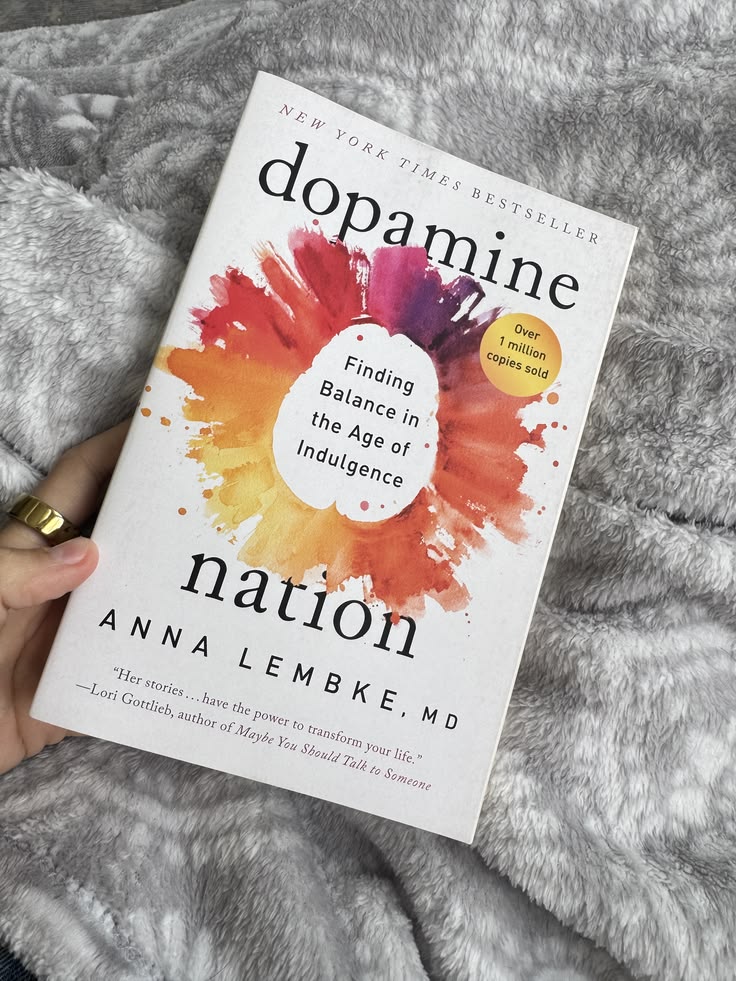
You finish a good meal and immediately look for something sweet. You close one video and open another. You check your phone between tasks, then wonder why a normal conversation, walk, or hour of work feels strangely flat. *Dopamine Nation* starts with that uncomfortable question: what happens when pleasure is always available, always stronger, and always one tap away?
Anna Lembke’s answer is not that pleasure is bad. It is that the brain adapts. When you keep reaching for quick, intense rewards, ordinary rewards can feel weaker by comparison—and the urge for another hit starts making decisions for you.
The book’s useful rule is to protect your baseline. Create enough space from compulsive rewards that work, rest, people, food, and ordinary life can become satisfying again without needing a constant upgrade.
The Book in 60 Seconds
*Dopamine Nation: Finding Balance in the Age of Indulgence* is psychiatrist Anna Lembke’s 2021 book about pleasure, pain, addiction, and overconsumption. It brings clinical stories and neuroscience together to explain why a world full of easy rewards can leave people more restless, anxious, and unsatisfied.
The book covers substances, gambling, food, sex, work, shopping, and digital media. Its argument is not that all of these are equally harmful or that every habit is an addiction. It is that modern life offers unusually potent rewards with almost no natural stopping point.
That matters because the same person can use a phone, food, work, or entertainment for a genuine benefit—and still notice that the behaviour has crossed a line. The important question is not whether the thing is “good” or “bad.” It is whether you are choosing it freely or using it to escape the feeling of not having it.
The relentless pursuit of pleasure leads to pain.Anna Lembke, Dopamine Nation official book description, 2021
That is the book’s central tension. A reward can feel good in the moment and still make the absence of that reward feel worse later. The result is a loop: seek relief, get a short lift, feel the drop, then seek relief again.
The Central Model: Pleasure and Pain Share a Balance
Lembke uses a simple seesaw idea. When the brain experiences a rewarding stimulus, it moves toward pleasure. To maintain balance, it pushes back in the other direction. You may not notice the pushback after one ordinary reward. You notice it when the reward becomes frequent, intense, and easy to repeat.
The pushback can look familiar: irritability without the phone, boredom after a day of feeds, a need for more sugar after the first sweet thing, or the sense that quiet work has become impossible to start. None of those feelings proves an addiction. They are signals worth observing.
The brain responds to this increase by decreasing dopamine transmission — not just back down to its natural baseline rate, but below that baseline.Anna Lembke, Stanford Medicine, 2021
The practical lesson is not to diagnose yourself from a paragraph. It is to stop treating low-level dissatisfaction as proof that you need another reward. Sometimes the craving is the after-effect of the last one, not evidence that the next one will solve anything.
This is why the book feels useful beyond addiction medicine. Many productivity problems are reward-design problems. A task feels slow after an hour of instant inputs. A quiet evening feels empty after a high-stimulation day. The brain has been taught what pace of reward to expect.
The Three Ideas Worth Keeping
First, availability changes behaviour. A reward that is cheap, private, fast, and always nearby asks far more of your self-control than one that has friction. If the snack, app, shop, video, or game lives one tap away, you will encounter the decision more often than you think.
That means willpower is rarely the first lever. Change the distance. Log out, move the app, leave the device outside the room, do not buy the thing automatically, set a defined finish time, or make the cue less visible. Friction is not punishment. It gives your deliberate brain time to join the decision.
Second, abstinence can be a diagnostic tool, not an identity. Lembke writes about taking a deliberate break from a problem behaviour to see what changes. A break can reveal cravings, triggers, time costs, withdrawal-like discomfort, and the activities the behaviour had been replacing.
For a non-dangerous everyday habit, the question becomes simple: what would I learn from a short, defined pause? If you cannot imagine one day without checking a certain app, buying something, drinking, gambling, gaming, or working late, that reaction is useful information. Some behaviours need clinical support to change safely; a personal experiment is not a substitute for care.
Third, recovery requires replacement, not a white empty space. If you remove the reward but keep the same tired, lonely, bored, stressed, or unstructured moment, the old loop has done nothing wrong from the brain’s point of view—it was solving a problem, however badly.
Replace the loop with something that changes your state or your environment: a walk, a shower, a meal, a call, a short task with a visible end, a gym session, music without scrolling, or sleep. The replacement does not need to feel as exciting. It needs to make the next choice easier.
Why More Can Start Feeling Like Normal
The most unsettling part of the book is that people can chase a reward after it stops feeling especially good. The behaviour remains because stopping feels worse. The brain has adjusted its expectation, so the reward is no longer a bonus; it is a way to escape the dip.
People use more just to feel normal.Anna Lembke, Stanford Medicine, 2025
That sentence should make you cautious with your language. It does not mean every extra coffee or late-night show is a medical problem. It means that when you find yourself repeatedly increasing the dose, frequency, or intensity of something while getting less satisfaction from it, the pattern deserves a closer look.
A useful example is the afternoon phone loop. You feel a little tired or stuck, so you open a feed for a minute. Ten minutes later the task feels even duller. You need another input before you can restart. The phone did not create the original tiredness, but it may have trained the brain to expect a faster reward than the task can offer.
The Twenty-Four-Hour Baseline Reset
Choose one low-risk behaviour that repeatedly takes more than it gives: an endless feed, non-essential online shopping, background video, a particular game, junk notifications, or grazing through snacks. Do not choose alcohol, drugs, self-harm, eating-disorder behaviour, or anything where abrupt change could be unsafe; seek appropriate clinical guidance for those concerns.
For twenty-four hours, make the behaviour unavailable. Remove the app from the home screen, keep the device outside the bedroom, do not enter the shop, or set a physical boundary that makes the automatic choice harder. Be precise. “Use my phone less” is vague. “No social feed from waking until after dinner” is observable.
Before the pause begins, choose two replacements for the moments when the urge normally appears. If you scroll after lunch, plan a ten-minute walk and one small task. If you shop when stressed, plan a call and a list of the actual need. You are not trying to be empty. You are trying to see the loop clearly.
Rize AI can protect these replacement blocks inside the day you already have. A phone-free first hour, a short walk after lunch, or a shutdown routine works only when it has a place beside your real commitments. The calendar is where the book becomes a changed pattern instead of another insight you admired.
A Normal Example: The Workday That Keeps Breaking
A designer says she cannot focus for more than twenty minutes. Her task is not impossible; she simply checks messages, news, and short videos whenever the work becomes uncertain. At the end of the day she has been busy but has not moved the design far enough to feel settled.
She runs the baseline reset with the highest-friction change first: her phone stays in another room for one 45-minute work block. She writes the next design decision on paper before beginning and plans a ten-minute walk after the block. The first few attempts feel boring and restless. That is data, not failure.
After four days, she notices the urge peaks early and falls when the next action is visible. She has not “detoxed dopamine.” She has interrupted one loop and learned that the uncomfortable start of focused work does not require a screen to resolve it.
What People Get Wrong About Dopamine Nation
The biggest mistake is turning dopamine into a villain. Dopamine is involved in motivation, movement, learning, and reward. You do not want no dopamine, and you cannot reduce a complex brain system to one social-media trick.
The second mistake is using “dopamine detox” as a dramatic weekend cleanse, then returning to the exact same environment. The book’s value is not self-denial theatre. It is learning which rewards have become compulsive, creating enough distance to see them, and building a life that does not need constant stimulation to feel bearable.
The third mistake is trying to self-treat serious addiction alone. If a substance, behaviour, or mental-health concern is causing harm, withdrawal symptoms, financial danger, unsafe behaviour, or repeated failed attempts to stop, professional help is the right next move. A productivity article cannot replace it.
Run a Seven-Day Baseline Test
For seven days, keep the twenty-four-hour boundary around one low-risk reward loop. Do not make the experiment bigger halfway through. Track when the urge appears, what usually triggers it, which replacement worked, and whether ordinary activities become easier to return to.
At the end, ask three questions: did the behaviour take less time than I assumed, did the urge have a predictable trigger, and what boundary made the good choice easier? Keep one boundary that worked. You are designing the environment, not proving that you are strong enough to fight it forever.
The book’s lasting point is not that modern rewards must disappear. It is that a life built around the next fix eventually makes ordinary life harder to enjoy. Protect the baseline, and the quieter parts of the day regain some of their value.
- Choose one low-risk reward loop. Pick something that repeatedly takes more than it gives.
- Set one clear twenty-four-hour boundary. Make the behaviour observable and harder to access.
- Plan two replacements first. Give the urge a safer, useful alternative rather than an empty gap.
- Review after seven days. Keep the boundary that makes ordinary work, rest, and connection easier to return to.
The rules worth keeping
Repeated intense rewards can make ordinary rewards feel weaker by comparison.
Make the compulsive option less immediate so deliberate choice has time to appear.
A short break from a low-risk loop can reveal cravings, triggers, and hidden costs.
Plan a real alternative for the moment the old reward used to solve.
Serious addiction and unsafe withdrawal require professional help, not a self-run experiment.